
Eber’s water towers 2025
The leading trade journal in Sweden, VA-tidskriften Cirkulation has since 1998 an article series under the heading Ebers vattentorn (Eber’s water towers), where Eber Ohlsson with text and photo presents interesting water towers in the world (except Scania and Sweden). Below is a free translation to English of these texts.
Eber’s water towers in Cirkulation 1/2025

A free translation to English:
At the time when the railway was boiling water to power their steam engines, it needed a lot of water. Therefore got steam trains at certain intervals make a pause on their journey to fill the tanks with fresh water. A good way to do these operations fast was to store the water in the water tower. These did not, however, be as high as the towers for the needs of the society.
Such a railroad water tower in wood is still standing in the small town of Centralia in southern Illinois, USA. The town, which gets its name from its function as a railway junction, still fills a central role for the railway.
Published 2025-02-12
Eber’s water towers in Cirkulation 2/2025
A free translation to English:
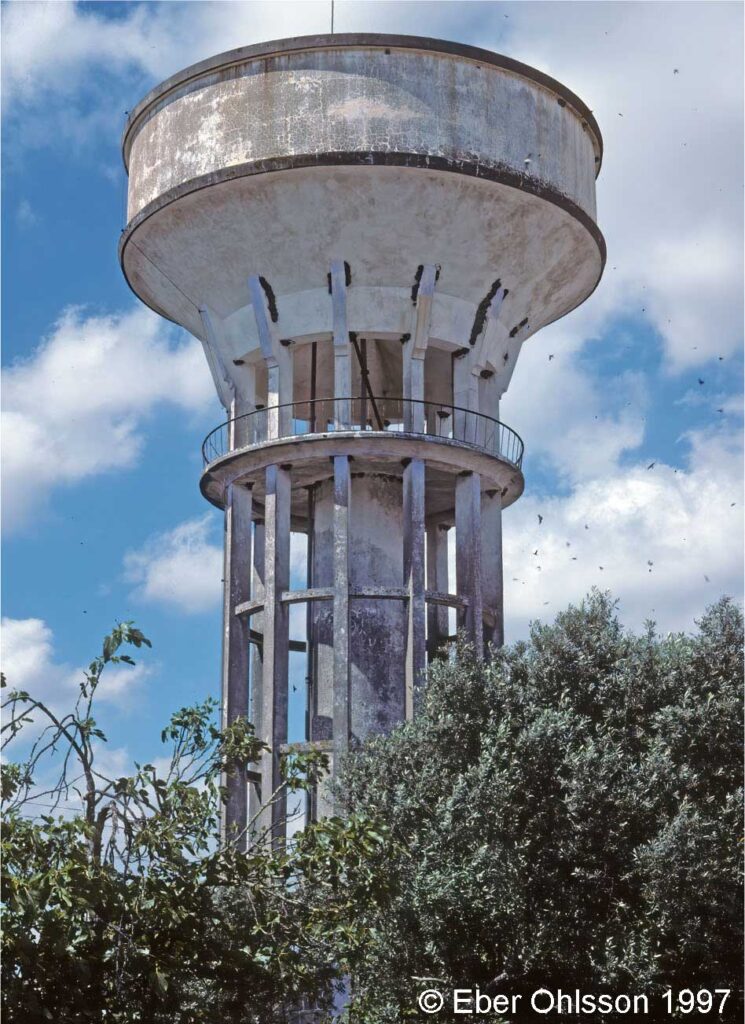
It is the water level that is interesting when building a water tower, but you want to limit the water depth, so as not to get poor water circulation. It happens that the unused prospective building volume under the reservoir is planned for housing.
However, not all housing are planned, but sometimes spontaneous settlement occurs, such as the water tower in the northern Portuguese town of Alpalhão. According to a knowledgeable ornithologist, Common House Martin (Delichon urbicum) have built nests here. For an amateur, the thought goes easily to Swifts, now known as Common Swift (Apus apus). The swallows’ nests in the picture could otherwise perhaps be called nests for Water Tower Swallows.
Published 2025-03-19
Eber’s water towers in Cirkulation 3/2025
A free translation to English:
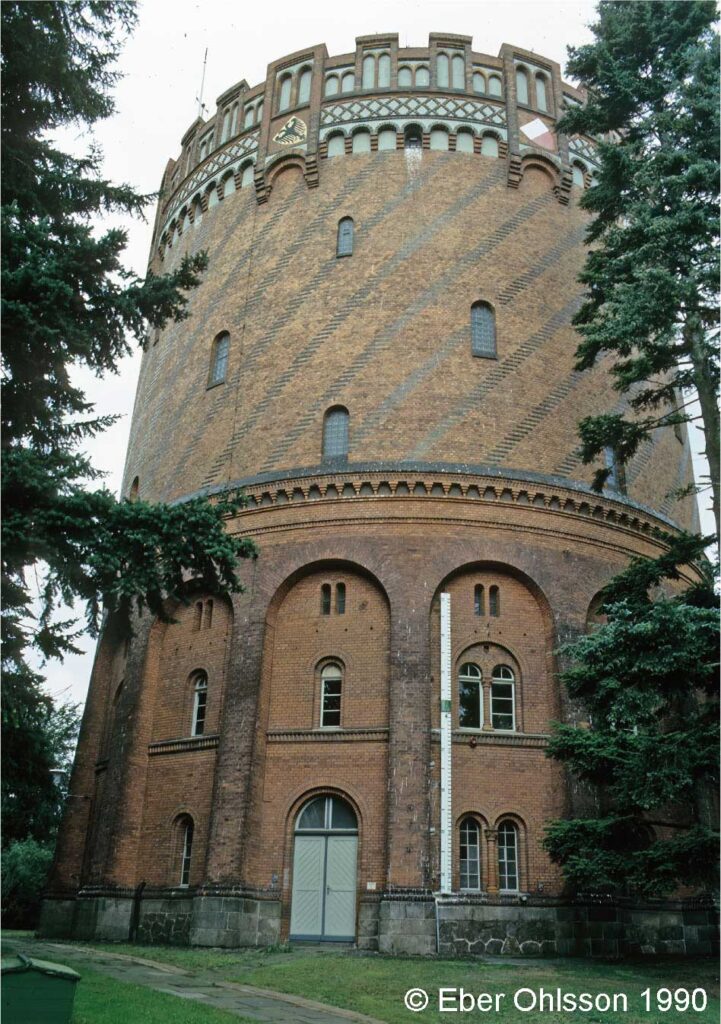
In the old Hanseatic city of Lübeck in Germany, there is a water tower, where the brick facade already tells of a composition in stages. The lower part of the water tower is the tower, which was completed in 1867 with a cast iron cylinder reservoir of about 1,000 m3 and a 25 m high standpipe.
Over time, a continuously higher water pressure was required, so the tower was strengthened and extended in 1890, so that it now became 30 m high and had an Intze reservoir of 2,100 m3. The lower part of the tower was rebuilt into a waterworks office and laboratory. Since 1927, with higher demands on water pressure, the tower has had the function of a leveling reservoir.
Published 2025-04-23
Eber’s water towers in Cirkulation 4/2025

A free translation to English:
There are many examples in both time and space of health resorts that provide enriched water, although the additives may vary for the different health waters. Latvia is no exception. In Ķemeri, 40 km west of Riga, there has been a health resort since the Tsarist era that has provided care with sulfur-containing water.
This health resort received a 42 m high water tower in 1929, designed by architect Friedrich Skujins. The reservoir held 100 m3 of sulfur-containing water. Previously, there was a viewing platform at the top of the tower. After the collapse of the Soviet era, the tower has now regained its full glory.
Published 2025-06-04
Eber’s water towers in Cirkulation 5/2025

A free translation to English:
In Darmstadt, a city in Hesse, Germany, there is a distinctive water tower near the city’s central station and next to the historic Dornheimer Bridge, which bridges the railway yard. The 41-meter-high Barkhausen-type tower, with a cylinder volume of 400 m3, was completed in 1910, designed in Art Nouveau style by architect Friedrich Mettegang.
The tower in plastered brick and with a slate roof once housed a switchgear. When the railway no longer needed the tower, they wanted to demolish it, but it was not something the people of Darmstadt wished The tower became a cultural monument in 1978 and was sold in 1986 to an architect, who has created a smaller culture house here.
Published 2025-09-27
Eber’s water towers in Cirkulation 6/2025

A free translation to English:
The number of water towers that have been converted into homes has increased. The reason may be that when water towers has been taken out of operation, the question has arisen as to what to do with these towers in that case. If the water towers have been a distinctive and popular part of the urban environment, the question is what other function the tower can then have, if the tower is not to be demolished.
In Belgium, on one of the highest points in the municipality of Sint-Pieters-Leeuw, located southwest of Brussels in Flemish Brabant, stands a water tower built in 1933-1934 and was in operation until 1955. Here this tower in 1999 became a private residence , with a wide view.
Published 2025-10-01
Eber’s water towers in Cirkulation 7/2025

A free translation to English:
In the small Swedish town of Stanton in Iowa in the USA, there has long been a water tower shaped like a coffee pot. When the city needed a new water tower in 2000, the obvious shape – a coffee cup on a plate – became, like the coffee pot, richly-decorated florial motif. In the same year, it was named “Steel Water Tower of the Year”.
The 29 meter high water tower, where the handle is 2.7 meters high, holds 570 m3 of water. The connection to a coffee cup is historically understandable, but the tower is more like a tea cup on a saucer. The risk that the water tower will one day fly into space like a flying saucer can probably be judged to be negligible.
Published 2025-11-05
Eber’s water towers in Cirkulation 8/2025

A free translation to English:
Gedser on the island of Falster is as far south as you can get in Denmark. Here is also one of Denmark’s southernmost water towers. It was built in 1912 and was in operation until 1966 and was designed by the famous water tower architect Alf Jørgensen. The reinforced concrete tower is 18.5 meters high and had a reservoir of 460 m3.
As Gedser is located at the far end of a headland, it is not surprising that it is now a lookout tower. The Friends of the Water Tower Association bought the tower for one crown in 1994, and here during the summer the public has the opportunity to go up the stairs and look out over the southern Baltic Sea and perhaps see the German coast.
Published 2025-12-10
 English
  Swedish